Enzo Sari Systems and networks apprentice on a BUT R&T, Cybersecurity track

I'm in the 3rd year of a BUT at IUT de Blagnac, and I've been an apprentice at INDYSystem since September 2026: I install Proxmox servers there for clients, with the technicians.

At home, my photos, passwords and messaging run on my own server. In 2027, I'm aiming for an engineering school in networks, systems or cybersecurity.

At a glance

  • INDYSystem current

    Apprenticeship · since September 2026

  • IUT de Blagnac

    BUT R&T, 3rd year · Cybersecurity track

  • Mecaprotec Industries

    Internship · April – June 2026

  • Lycée Stéphane Hessel

    Bac STI2D, SIN option · 2024

English C1 (TOEIC) · Cisco ITN course · SecNumacadémie MOOC (ANSSI)

My experience

Since September 2026

BUT year 3 apprenticeship · until 2027

Systems, networks and telecoms apprentice

INDYSystem · Montauban, north of Toulouse · IT provider with fewer than 20 staff, for small businesses and local authorities

  • I've installed two Proxmox servers for clients, with the technicians: the company is moving the virtualisation platforms it manages from VMware ESXi to Proxmox VE.
  • I go with the technicians to client sites to learn: servers, maintenance, 3CX telephony.
What a Proxmox installation involves

Gathering the requirements, then fitting the disks (SSD or HDD), memory and other components, creating the hardware RAID or, failing that, software redundancy with ZFS in Proxmox, and finally installing and testing the requested VMs.

An HPE server with a fan stuck at full speed

On an HPE server meant for Proxmox, a fan was running constantly at nearly 100%, even in the BIOS. I led the diagnosis over several weeks: drivers first, then firmware updates (iLO, BIOS…), reseating the power supplies, changing the operating system, and finally removing the disks one by one.

That last test gave the answer: the fan speed shot up as soon as the disks were inserted. These 15,000 rpm disks were running hot and weren't listed in the server's QuickSpecs. Once they were replaced with compatible 10,000 rpm models, the fans dropped back to 20%.

My takeaway: isolate the components one by one, and check the QuickSpecs before looking at the software side.
April – June 2026

BUT year 2 internship · 10 weeks

Windows systems administrator and IT support technician

Mecaprotec Industries · Muret, near Toulouse · surface treatment for the aerospace industry · group of about 1,080 employees

In the IT department, during the migration from the old LDAP directory to Active Directory.

  • I replaced 60 workshop thin clients with Windows 11 mini PCs: joining the domain, Group Policy (GPO), GLPI inventory and on-site installation.
  • On GLPI support, I handled about 5 tickets a week, almost on my own by the end of the internship, and entirely on my own for a week while my supervisor was away.
  • On the security side: I disabled and then deleted the Active Directory accounts of people who had left, and created a cybersecurity awareness module for all employees.
Internship details
  • My supervisor's PowerShell scripts brought the setup of a computer down to about 20 minutes. I gathered the workshop managers' requirements, checked the EDR and installed the computers in the workshops, wearing PPE.
  • I replaced about ten all-in-one PCs with laptops and USB-C hubs, for remote working: data backup, business software, VPN.
  • Support examples: an error loop when signing in to Teams, which neither clearing the cache nor reinstalling Teams fixed, but a clean reinstall of Windows 11 did; Excel macros recovered over RDP from a user's old computer.
  • Two shared workshop computers locked after going to sleep, and the operators had no password to unlock them. I created a GPO that stops only these two computers from locking, then wrote a tutorial.
  • For leavers' accounts, we started from the staff list provided by HR; I disabled those accounts, then deleted them in batches of 10.
  • I migrated about twenty computers to Windows 11 and enrolled about twenty company smartphones in the mobile security solution.
  • I created two modules on 360Learning: the IT welcome booklet, and “Cybersécurité – Vigilance quotidienne” (“everyday cybersecurity vigilance”), 5 to 10 minutes of scenarios on six topics (phishing, passwords, reporting, personal devices, network, social media).

Other experience

2023 Seasonal farm worker (topping) · GE De Pontet, Nohic (Tarn-et-Garonne)

My projects

Personal project Since 2022 · on my own, from design to day-to-day running

My homelab: three sites linked by VPN

I host my own photos, passwords, messaging and home automation, so that my data stays at home. Around twenty services run on a TrueNAS server, linked to two other locations by a WireGuard VPN.

  • Sensitive services can only be reached locally or over the VPN, with passkey single sign-on.
  • Two problems described in the case study: a “successful” call that was actually going through the VPN, and a network card that kept failing during transcoding.

Read the case study

Outside my studies June 2026 · networking, Wi-Fi and video surveillance

Cameras for a municipal campsite: where should the footage go?

The job was to add about ten cameras to a municipal campsite's network, then choose where to store the recordings; price mattered.

  1. ISP box

    ADSL < 10 Mb/s, shared with the campers' Wi-Fi

  2. MikroTik router

    managed by a contractor

  3. PoE+ switch

    powers the Wi-Fi access points

  4. 5 outdoor Wi-Fi access points

    campers' Wi-Fi + camera SSID (WPA2, 2.4 GHz)

    Compact NVR

    local recording, in the rack

  • Campers' network
  • Camera VLAN
Simplified diagram of the network chain. The camera VLAN starts at the MikroTik router.

Three architectures compared

  1. Ruled out Reuse a PC tower as an NVR

    The equipment room only has space for a mini PC or a NUC.

  2. Ruled out A PC in the house next door, linked by VPN

    The camera streams would have saturated the ADSL line, and with it the campers' Wi-Fi.

  3. Installed A compact NVR and its disks in the rack

    Local recording: the camera streams don't leave the campsite network. Only remote viewing goes over the Internet, through a single stream provided by the NVR.

  • I had the contractor who manages the router create the camera VLAN, then extended it to the access points with a dedicated SSID. Wi-Fi rather than cabling, to get everything installed before the high season.
  • I installed the NVR and its disks in the rack, and signs mark the areas being filmed.

University project SAÉ 41 · BUT year 2, semester 4 · team project · PNETLab

Multi-site company project

We simulated a realistic company's architecture: routing, security, VPN and services.

  • Servers and clients separated into two VRFs; all traffic between VLANs goes through the FortiGate firewall (7 filtering policies, DMZ). OSPF in each VRF and an IPsec tunnel between the sites.
  • The simulated hardware forced us to adapt the design: SVIs, because the Arista vEOS switches didn't support 802.1Q subinterfaces, and static routes per VRF, because OSPF wasn't redistributing the default route to them. As for the SSL VPN, it didn't work.

In semester 3 (SAÉ 33), a secure multi-site network in GNS3: OSPF, BGP, IPsec, FortiGate and Sophos firewalls, and a final presentation prepared in English.

University project BUT year 1 · February 2025 · pair work

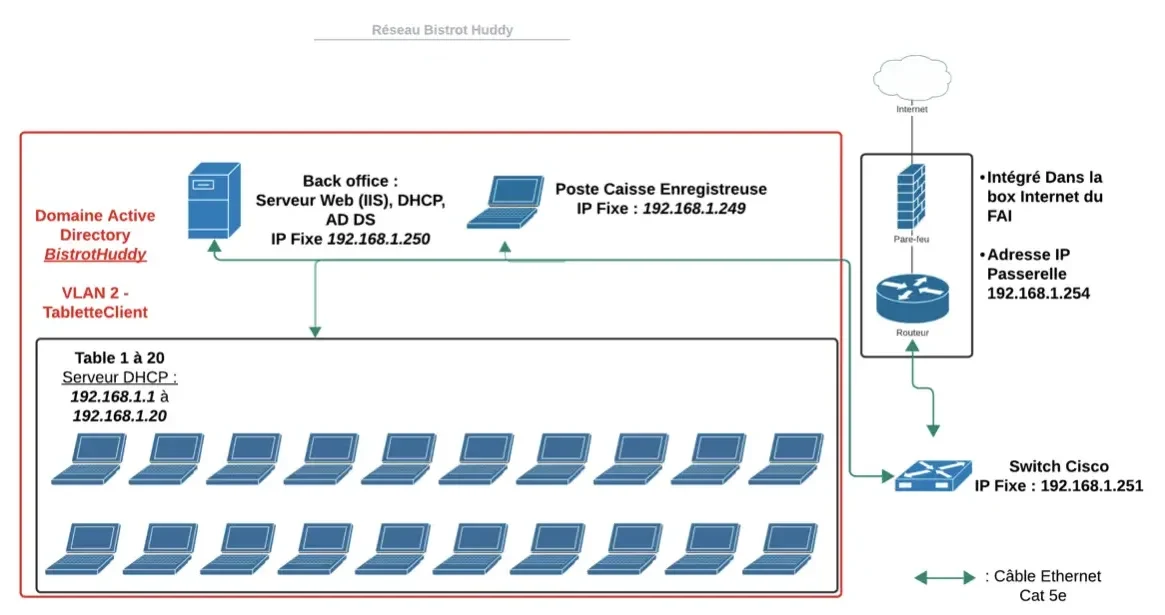
The network for a fictional restaurant, the “Bistrot Huddy”

We designed a restaurant's network: Active Directory domain, DHCP and IIS web server on Windows Server, Cisco switch, and a VLAN for the 20 customer tablets.

Network diagram of the Bistrot Huddy: Active Directory domain, back-office server (IIS, DHCP, AD DS), till computer, VLAN for the 20 customer tablets, Cisco switch and ISP box. (enlarge image)

University project SAÉ 15 · BUT year 1 · December 2024 – January 2025 · in a pair

From temperature sensors to a web page

  • Collecting the measurements as JSON over MQTT.
  • Calculating the average, minimum and maximum for each room in Bash.
  • Automatically generating a web page (HTML and CSS) with the readings and statistics.

My skills

The five competencies of the BUT in Networks & Telecoms, two of them specific to the Cybersecurity track, and where I've put them into practice.

What I use

Systems

Windows 10 / 11 · macOS · Linux (Debian) · Active Directory and GPO · GLPI · HPE servers (iLO)

Virtualisation and storage

Proxmox VE · VMware · Docker · TrueNAS SCALE (ZFS)

Networking and security

VLANs · OSPF · IPsec · FortiGate · WireGuard · HTTPS reverse proxy · passkey SSO

Monitoring and automation

Netdata · Centreon (currently learning) · n8n · Bash

Languages

French (native) · English C1 (TOEIC) · Spanish (basic)

My education

  1. –

    In progress, as an apprentice

    BUT in Networks & Telecommunications, Cybersecurity track

    IUT de Blagnac

    BUT (Bachelor Universitaire de Technologie, three-year degree).

    About the IUT (in French) (opens in a new tab)
  2. –

    Baccalauréat STI2D, SIN option

    Lycée Stéphane Hessel, Toulouse · mention Assez Bien

Courses and certificates

Cisco Networking Academy 2025

CCNA: Introduction to Networks (ITN)

The first of the three courses in the CCNA track, separate from the certification exam: networking basics, IPv4 and IPv6 addressing, basic Cisco configuration.

ANSSI February 2025

SecNumacadémie, the MOOC from ANSSI (the French cybersecurity agency)

Certificate of completion, with scores of 84 to 92% in the four assessments.

View the certificate

After 2027?

An engineering school

Three directions appeal to me: systems (cloud, virtualisation, Docker), to go further than my homelab; networking, like what I'm discovering at INDYSystem; or cybersecurity, especially cloud and enterprise security.

Space and healthcare

The two sectors I'd like to work in, on the network or container side: healthcare, for a job that has a direct impact on people, and space, my passion. In my career project at the IUT, I targeted Airbus Defence and Space, CNES and ESA.

Outside my studies

Space, more than a hobby

Space is a real passion of mine. I read a lot about it: news from the missions, new scientific discoveries. One day I'd like to buy a telescope and observe the stars myself, but not just yet.

3D printing, for made-to-measure parts

I like repairing things or making what you can't buy ready-made, such as storage cut to exact dimensions. When I need a truly custom part, I model it myself in SolidWorks, which I learnt the basics of in my STI2D baccalaureate. It's the same logic as my homelab: when the solution I need doesn't exist, I build it.

And also home automation, which runs on my homelab, electronics, and sport: running and mountain biking, simply because I enjoy them.

Any questions?

Contact me

A question about a project, my apprenticeship or my engineering school plans? Email me or use the form.

The form is provided by Tally. It only loads if you ask for it: Tally then receives your IP address and technical information about your browser.

Or: open the form on tally.so (opens in a new tab)